RAGaaS (Retrieval-Augmented Generation as a Service)

Overview: In an era where speed-to-market and AI reliability are paramount, TrieDatum played a pivotal role in architecting and implementing a cutting-edge "RAG-as-a-Service" (RAGaaS) platform. This strategic initiative was designed to empower enterprises to scale their generative AI capabilities efficiently. By providing a standardized, enterprise-grade foundation, the platform accelerates the lifecycle of Retrieval-Augmented Generation (RAG) applications—from rapid prototyping to full-scale deployment—while rigorously maintaining security, scalability, and governance standards across the entire organizational landscape.
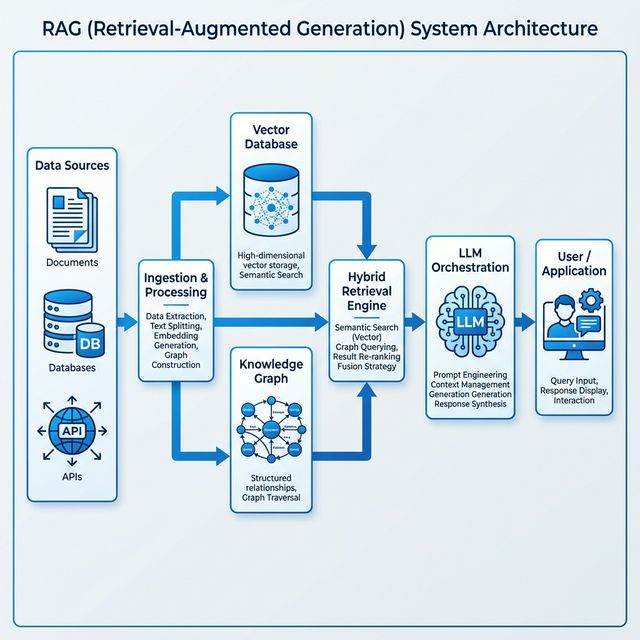
RAGaaS Architecture Diagram

The Challenge: Large organisations often face significant hurdles when attempting to operationalize RAG-based applications across diverse business units. Without a centralized framework, development efforts become siloed, resulting in a fragmented landscape of incompatible data ingestion pipelines, redundant infrastructure, and inconsistent security protocols. This lack of cohesion creates a "governance gap," leading to unmanaged risks, spiraling costs, and a significantly delayed "pilot-to-production" timeline. Furthermore, the absence of centralized administrative control makes it nearly impossible to enforce compliance or effectively optimize resource utilization.

The TrieDatum Contribution: TrieDatum served as a core architect and engineering partner in the development of this transformative platform. We engineered a robust, unified solution capable of synthesizing vast amounts of both structured and unstructured data through a sophisticated, multi-layer orchestration engine.

Strategic Technical Pillars:

  • High-Velocity Data Ingestion & Vectorisation: We implemented a scalable, high-performance pipeline capable of ingesting and processing diverse data formats—from PDFs and text documents to complex database records. This system automatically cleans, chunks, and transforms data into high-dimensional vectors stored in an optimized vector database, ensuring sub-second retrieval latency.
  • Semantic Knowledge Enrichment: Going beyond simple keyword matching, we integrated a knowledge graph to map complex entity relationships. This layer enriches the creation process, allowing the AI to understand deeply contextual nuances and provide reasoning that aligns with specific domain logic.
  • Advanced Retrieval & LLM Orchestration: Our hybrid retrieval engine uniquely combines the precision of vector search with the depth of graph traversal. By orchestrating these retrieval methods with state-of-the-art Large Language Models (LLMs), the system generates responses that are not only accurate but also firmly grounded in enterprise facts, significantly minimizing the risk of hallucinations.
  • Secure Multi-Tenant Administration: Recognizing the need for departmental autonomy within a governed framework, we developed a comprehensive web-based administration console featuring granular Role-Based Access Control (RBAC). This empowers tenant administrators to securely manage their own workspaces, data connections, and configuration settings without compromising the integrity of the broader platform.

The Results & Impact: The deployment of the RAG-as-a-Service platform has established a new standard for the "Production-Ready" enterprise, functioning as a scalable blueprint for future AI innovation. By decoupling the complexity of the underlying AI infrastructure from application logic, business units can now focus on solving value-added problems rather than wrestling with technical plumbing.

  • Accelerated Innovation: Drastically reduced the time-to-market for new internal AI tools, enabling rapid experimentation and deployment across the enterprise.
  • Enhanced Decision Intelligence: Users now gain access to AI-driven insights that offer deep contextual summarization and answer complex queries with citations, fostering a culture of data-backed decision-making grounded in verifiable facts.
  • Operational Efficiency: The unified platform approach eliminated redundant development efforts and streamlined maintenance, resulting in significant cost savings and operational agility.